Silver, Supply Chains, and the Reassertion of the Monroe Doctrine
This is what a Silver Reckoning looks like. Markets are repricing access as supply chains get reshored and geo-economics again outranks ideology. Silver reflects that shift in real time more than other assets. It’s price movement is being registered before policy formalizes changes already visible in physical flows.
Silver has been the most suppressed asset on earth, and it therefore has the most to gain. Below we explain what is happening behind the price action and why it should continue for quite some time.
Executive Summary
Silver’s recent price behavior is not the result of speculative enthusiasm or retail excess. It reflects a structural contest over natural resources in the Western Hemisphere, as the United States moves to displace China from Latin American supply chains. What appears as volatility is the market registering a geopolitical realignment already underway.
Silver is not moving because of speculation. It is moving because control over supply chains is changing.
I. China’s Five-Year Offtake Strategy
For roughly the past five years, China has pursued a deliberate strategy of acquiring raw materials directly from source. In Latin America, this meant buying silver, precious metals, and base metals in concentrate or doré form directly from mines, bypassing traditional market channels.
By purchasing offtake before final production, China secured supply before price discovery. The metal never reached open exchanges, never faced transparent competition, and never reflected market-clearing prices. It was acquired upstream and quietly absorbed into China’s processing system.
This strategy concentrated heavily in Latin America. Producers were offered higher prices for raw material and long-term certainty. Many accepted. Over time, visible supply chains thinned, while price signals became increasingly detached from physical availability.
During this period, the United States failed to respond. Supply chain control eroded gradually, not through collapse, but through neglect.
China was not buying silver at market prices. It was buying supply before markets ever saw it.
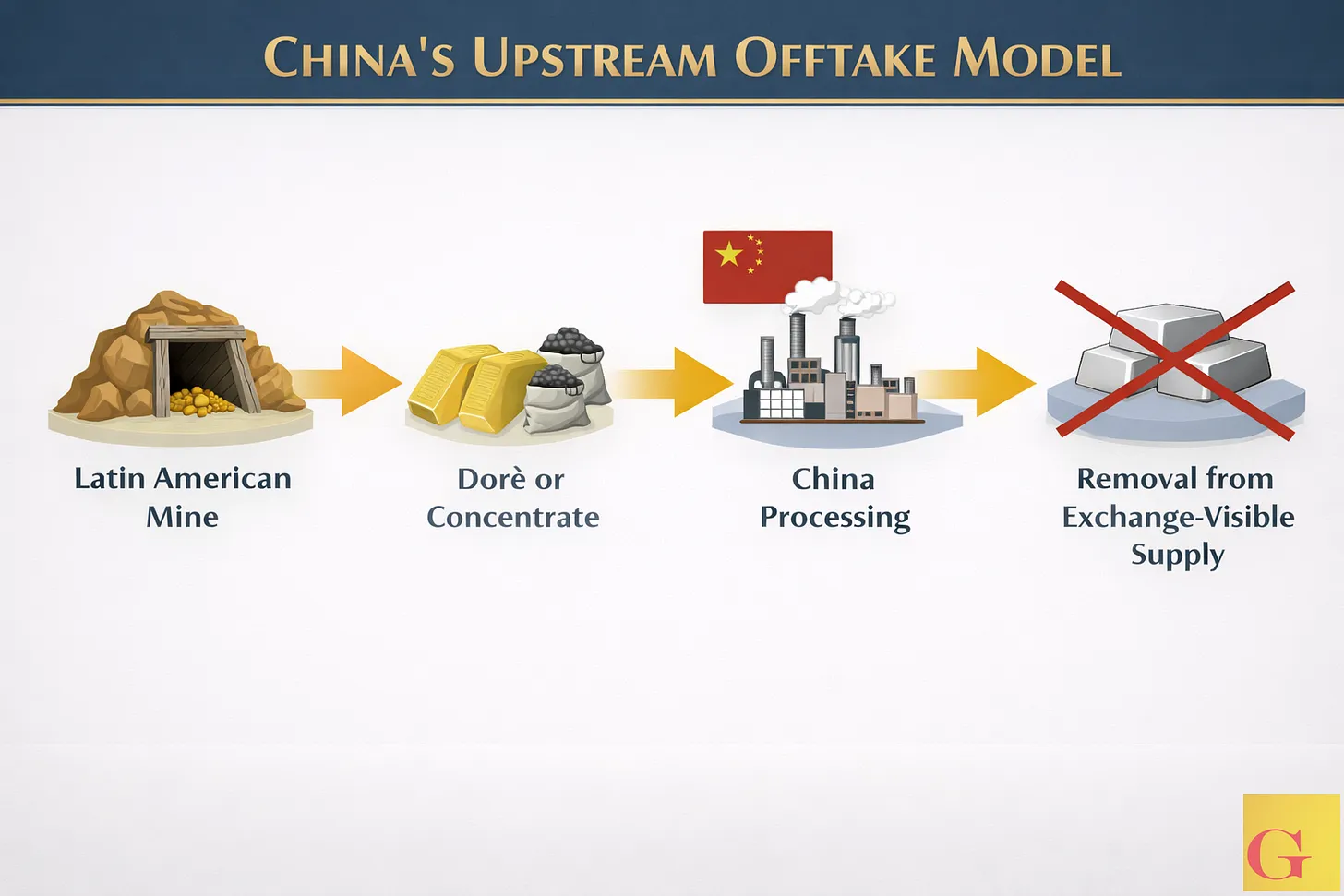
“China’s Upstream Offtake Model”
Latin American mine → concentrate or doré → Chinese processing → removal from exchange-visible supply.
II. The U.S. Response Begins at the Refinery Level
The shift in U.S. posture did not begin with an executive order. It began with physical bottlenecks from as far back as last year
U.S. refiners are now receiving unusually large volumes of silver concentrate from Latin America, to the point where refining capacity is overwhelmed. Material is arriving faster than it can be processed. This is a meaningful change.
Historically, much of this metal would have been refined for delivery into London or shipped onward to Asia. Instead, it is remaining in the United States.
At the same time, large U.S. buyers are securing offtake directly from producers. The United States is now doing in Latin America what China had been doing for years, only at greater speed and with greater urgency.
Price is not leading this shift. Control is.
The metal is arriving faster than it can be refined. That is not a price signal. That is a supply signal.
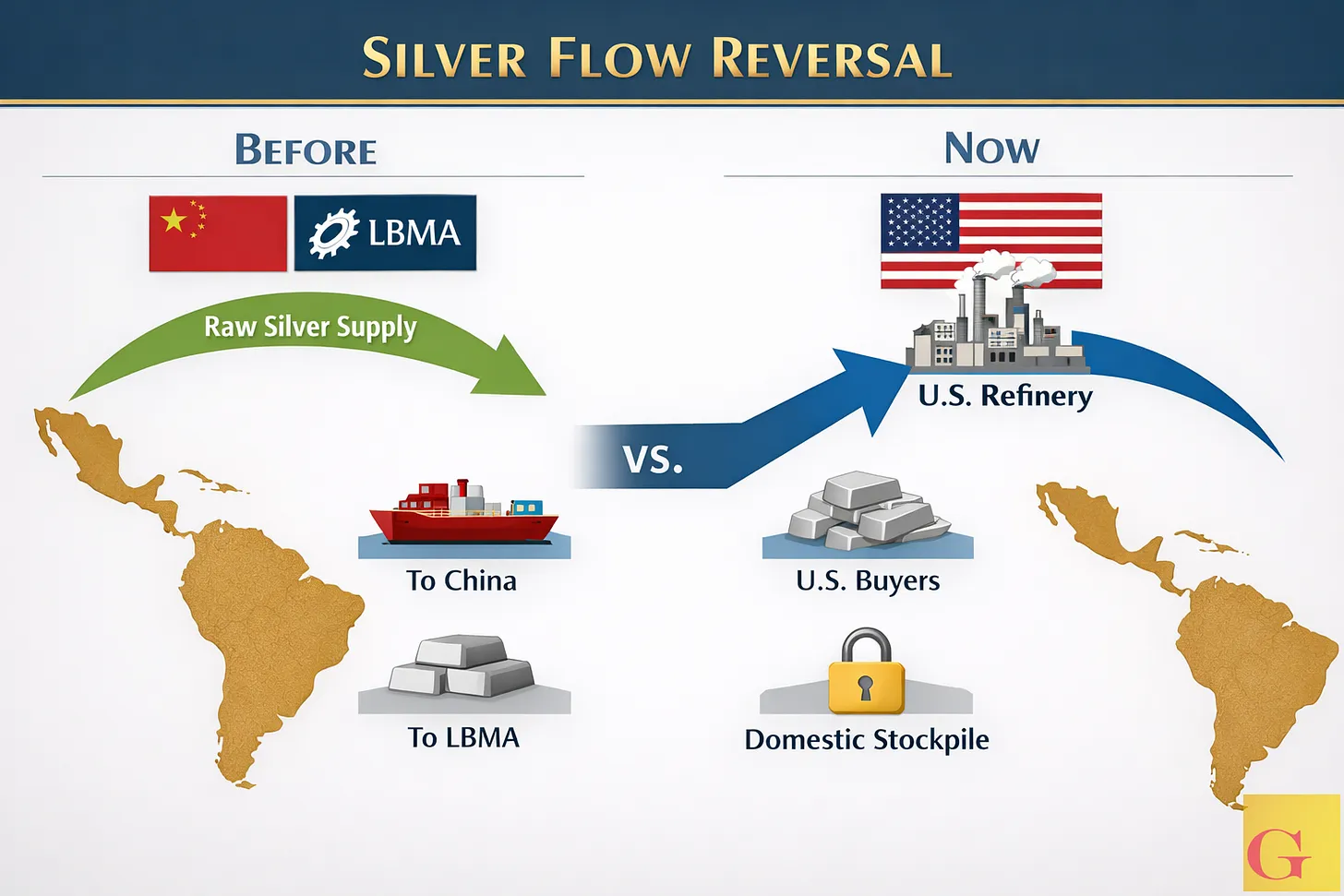
“Silver Flow Reversal”
Past flow: Latin America → China / LBMA :: Current flow: Latin America → U.S. refining bottleneck
III. The Significance of Vanishing Hedges
One of the clearest indicators that the market structure has changed is the disappearance of hedging.
Under normal conditions, unrefined silver entering the system would be hedged. Price exposure would be transferred. Risk would be managed. That behavior has materially declined.
The absence of hedging signals that buyers do not want price protection. They want the metal itself.
This distinction matters. Commercial inventory behaves differently than strategic inventory. When hedging disappears, price becomes secondary to access.
Whether this accumulation is being done directly for government purposes or indirectly through systemically important intermediaries is beside the point. The effect is the same. Physical silver is being absorbed without regard to short-term volatility.
Markets register this long before policy becomes explicit.
When hedging disappears, price no longer matters. Access does.
IV. China’s Bid for Finished Metal
As access to raw offtake tightens, China’s behavior has begun to shift.
Reports of Chinese buyers seeking finished silver at elevated prices suggest concern over supply continuity. Finished metal reflects control over refining, logistics, and delivery, not just access to ore.
This matters because China historically relied on upstream control. Requests for finished product imply that upstream access is no longer sufficient.
At the same time, China has announced intentions to restrict silver exports beginning next year. This follows a familiar pattern. When supply security weakens, export controls appear.
This is not speculative behavior. It is defensive positioning.
A bid for finished silver is an admission that upstream control is no longer enough.
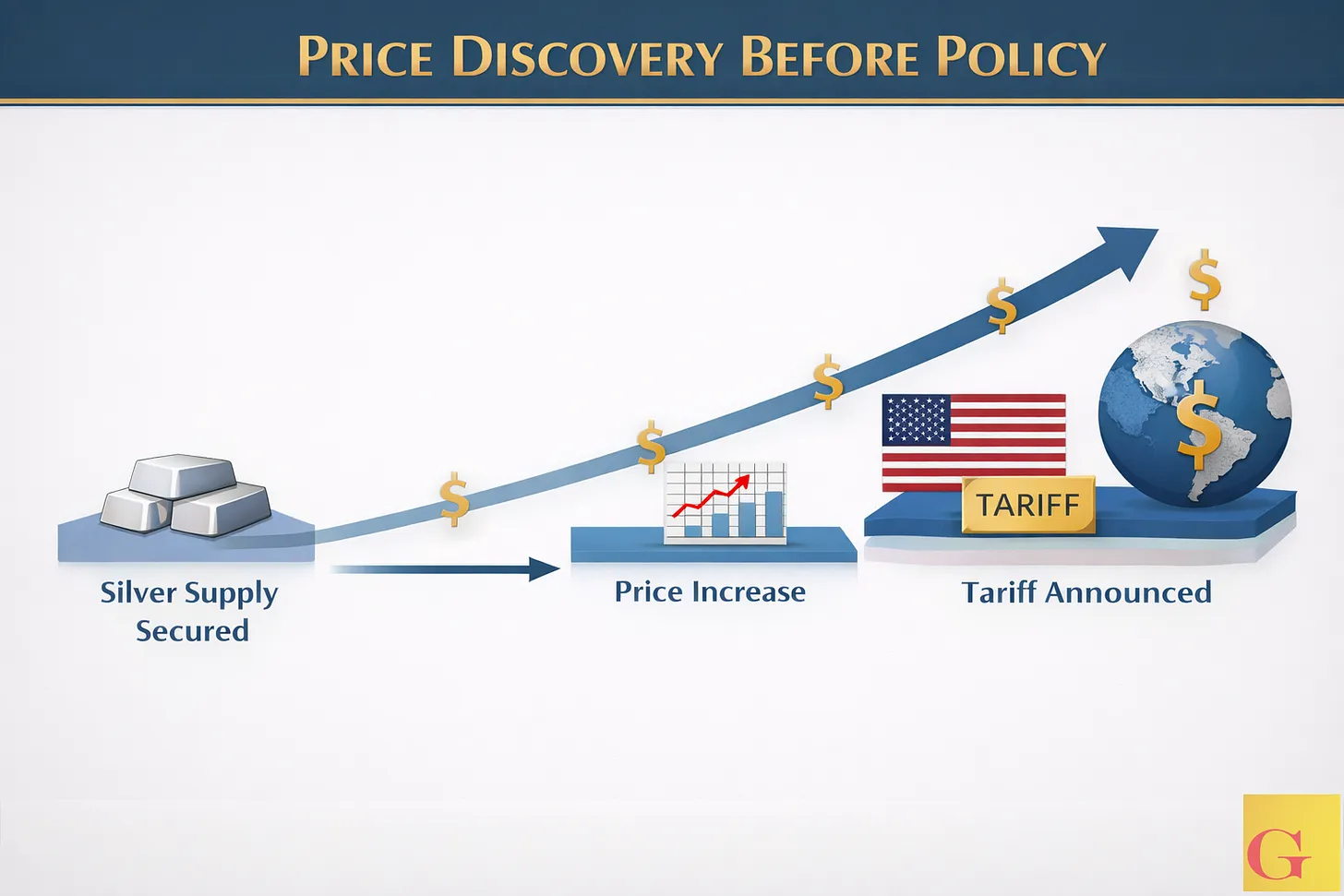
V. Section 232 and the Mechanics of Price Before Policy
Tariffs are often misunderstood as policy shocks. In reality, they tend to arrive after markets have already adjusted.
Under Section 232, the United States does not restrict commodities it still needs to accumulate. Tariffs follow supply security, not the other way around.
This explains why silver prices can rise sharply in the absence of explicit announcements. Markets front-run future constraints.
Once domestic and hemispheric supply chains are deemed sufficient, pricing mechanisms change. Tariffs need not target silver explicitly to reshape its price. Broad commodity measures are enough.
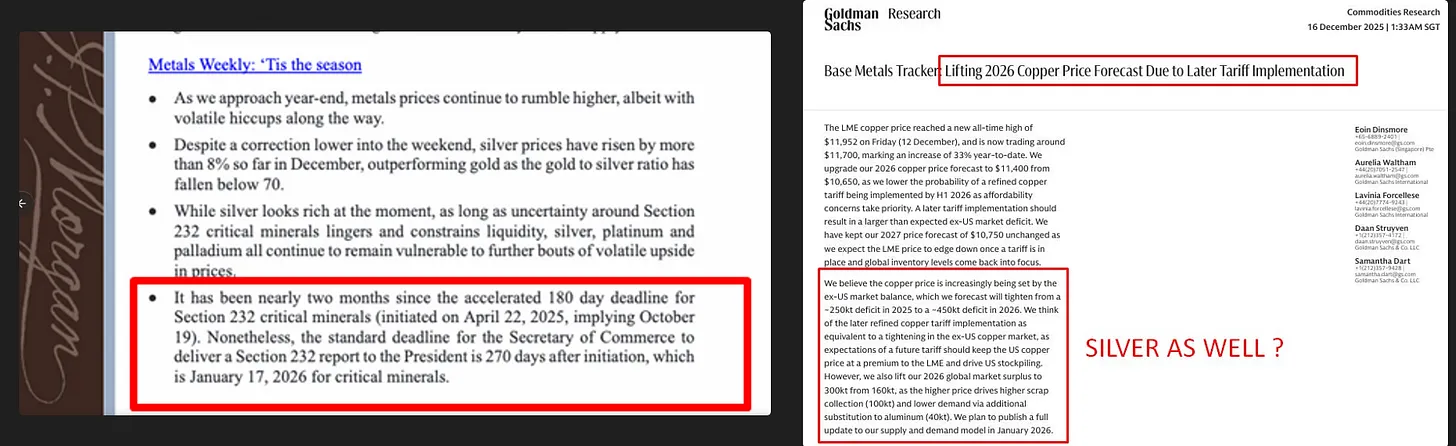
JPM and GS on 232 Risks 232…
JPM and Goldman Sachs Note the risks of 232 implementation in metals
Because the United States remains the marginal buyer at scale, its pricing decisions propagate globally. The tariff level becomes the reference price, as sellers rationally seek the highest available bid.
You do not tariff what you still need. You tariff what you already control.
China’s interest in silver should not be mistaken for an attempt to remonetize it.
Silver is poorly suited to serve as circulating money (even though practically speaking its perfect) due to its industrial consumption. History demonstrates that attempts to remonetize silver invite massive pushback
Its role is different.
As global trade shifts away from dollar-based settlement, collateral becomes more important. Gold fulfills this function, but gold is finite and increasingly encumbered. Silver occupies the next tier.
It is tangible, widely accepted, and divisible, while remaining embedded in industrial supply chains. That dual role creates tension, but it also creates strategic value.
Silver is not money. It is balance sheet collateral in a de-dollarizing system.
Silver does not need to be money to matter. It needs to be collateral.
VII. A Hemispheric Realignment
Taken together, these developments point to a broader conclusion.
The United States is reasserting control over natural resource supply chains in the Western Hemisphere. This is being executed through procurement, refining, and trade mechanics, not rhetoric.
China, after years of building upstream relationships, is encountering resistance. Supply chains that once appeared durable are beginning to fray.
This reflects a broader return to mercantilist logic. Nations are once again measuring security in physical resources rather than financial claims. Trust is declining. Redundancy is replacing efficiency.
Silver is not the cause of this shift but it is one of its clearest indicators.
Silver is a small market which reveals bigger geopolitical moves
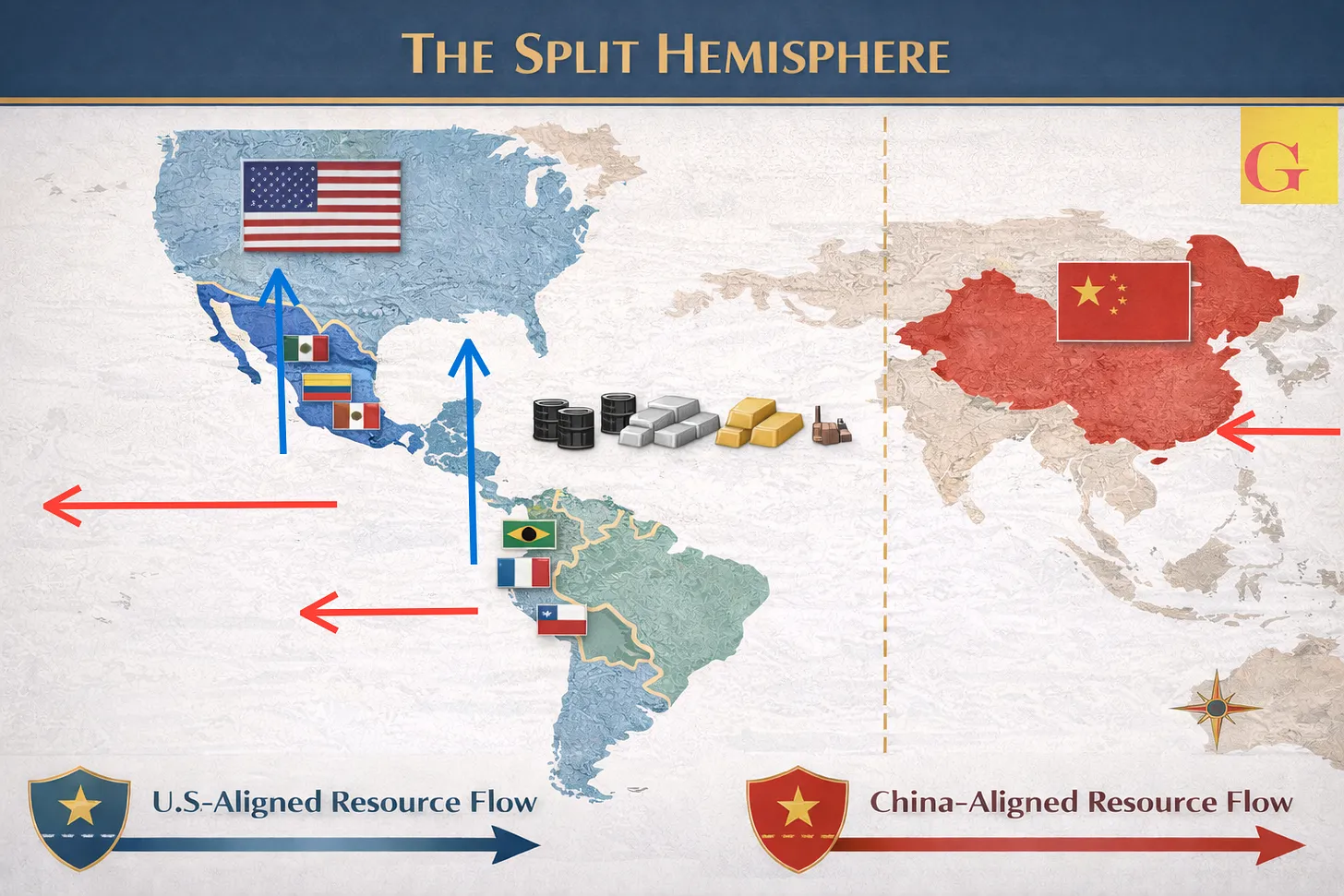
“The Split Hemisphere”
Map-style schematic showing U.S.-aligned vs China-aligned resource flows across Latin America.
Conclusion
The recent move in silver prices is not a bubble and not a retail phenomenon. It reflects a structural transition in how nations secure, price, and value critical resources.
Supply chains are being redrawn before policy is formally announced. By the time those announcements arrive, markets should have already adjusted.
The world is splitting along resource lines. Silver is registering that reality in real time.
About the Author
Vincent Lanci is a commodity trader, Professor of MBA Finance (adj.) , and publisher of theGoldFixnewsletter.